If you are starting a website and targeting a global audience, one of the first major decisions you will make is choosing your domain extension. Many people ask: .com vs .net which one is better?
By the end of guide, you will clearly understand the differences, the advantages, the risks, and which option is best for worldwide branding.
What Is a Domain Extension?
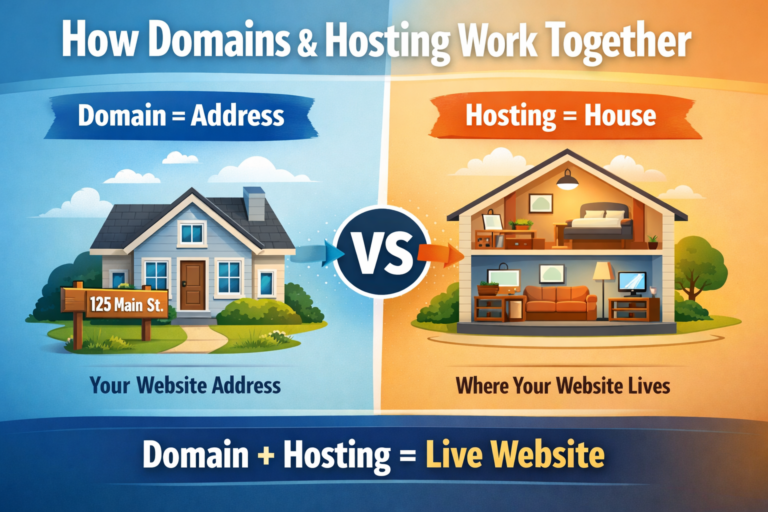
A domain name is your website’s address on the internet. For example: yourbrand.com and yourbrand.net The part after the dot is called the domain extension or top-level domain (TLD).
Think of your website like a physical store:
- The name of the store is your brand name.
- The extension (.com or .net) is like the location category.
Both .com and .net work technically the same way. They both allow your website to go live, send emails, and appear in search engines. The difference is not in how they function; it is in how people perceive them. And perception matters a lot when you are targeting a worldwide audience. Also Read on How to Choose a Domain Name
What is .com Domain Name Extension
The .com extension originally meant “commercial,” meaning it was created for businesses. Over time, it became the most widely used domain extension in the world.
Today, when people think of a website, they automatically think of .com. If someone hears your website name in a conversation, on a podcast, or in an advertisement, they will most likely type the .com version first; even if you never said “dot com.”
That automatic behavior gives .com a powerful advantage. Why is .com so strong?
- It is familiar worldwide
- It feels official
- It looks established
- It builds instant credibility
For global businesses, credibility is critical. When someone from another country visits your website for the first time, you want them to feel confident immediately.
In my experience working with website owners targeting international markets, .com domains consistently create fewer trust barriers for new visitors.
What is .net Domain Name Extension?
The .net extension originally stood for “network.” It was first used by internet service providers and technology companies. Today, .net is used by:
- Technology startups
- Software companies
- Online communities
- Businesses whose .com is already taken
There is nothing wrong with .net. It is legitimate, professional, and globally recognized. Search engines treat it the same as .com.
However, because it is less common, some users may see it as a secondary option; even though it is still credible. That difference in perception can influence user behavior.
The Real Difference Between .com vs .net
Technically speaking:
| Aspect | .com | .net |
|---|---|---|
| Search Engine Ranking | Can rank on search engines | Can rank on search engines |
| Email Hosting | Can host emails | Can host emails |
| Traffic Handling | Can handle traffic | Can handle traffic |
| Security | Secure when properly configured | Secure when properly configured |
| Psychological Perception | Default in people’s minds | Alternative in people’s minds |
| Global Audience Impact | Less risk of losing traffic due to automatic typing | Possible traffic loss if users type .com automatically |
Which Builds More Trust Worldwide?
When operating globally, trust becomes even more important because your audience may not yet be familiar with your brand. If someone in another country sees yourbrand.com, it feels standard and reliable, whereas yourbrand.net may create a small moment of hesitation. That hesitation might last only a second, but online, seconds matter.
From years of observing international websites, it’s clear that .com domains are typed correctly more often, receive more direct traffic, and are easier to promote in advertising. Businesses that later upgrade from .net to .com often report stronger brand confidence and smoother marketing efforts. Ultimately, trust is the foundation of global growth.
.Com vs .Net SEO: Does Google Rank .com Higher Than .net?

One of the biggest myths online is that search engines rank .com domains higher than .net domains simply because of the extension. In reality, rankings do not depend on whether your site uses .com or .net.
They depend on high-quality content, relevant keywords, strong backlinks, fast loading speed, mobile optimization, and a positive user experience. If two websites are identical in quality, one using .com and the other using .net search engines will treat them equally.
However, there can be an indirect effect: because users tend to trust .com more, they may click on it more often in search results. Higher click-through rates can improve performance over time. So any SEO difference is behavioral, not technical.
Branding Power and Long-Term Growth
Branding is about how people feel about your business, and when building a global brand, eliminating confusion is essential. Ask yourself which sounds more established: globalbrand.com or globalbrand.net.
Most people naturally assume the .com is the “main” website. In business presentations, investor meetings, and global advertising campaigns, a .com domain often signals long-term seriousness and credibility.
Many startups have struggled after launching with a .net while someone else owned the .com; over time, they either had to purchase the .com at a high price or rebrand entirely. Rebranding can be expensive and technically complex, which is why choosing the right domain from the beginning truly matters.
.Com vs .Net – Availability and Cost Differences
| Factor | .com | .net |
|---|---|---|
| Availability | Many short names already taken | More names still available |
| Popularity | Extremely popular | Less competitive |
| Premium Pricing | Premium domains can be expensive | Usually standard registration prices |
| Resale Market | Many domains held for resale | Fewer held for resale |
| Long-Term Strategy | Smart move if available at a fair price | Practical alternative if .com is overpriced |
| Strategic Consideration | Ideal for strong long-term positioning | Good balance when budget is limited |
When .net Might Be the Right Choice
There are situations where .net can be a strong and strategic choice. It works well if you operate in the technology or networking industry, if your budget is limited and you need to launch quickly, if the .com is unavailable and purchasing it would delay growth, or if your brand name fits naturally with .net.
In these cases, .net is not a downgrade but a practical decision. Many successful companies operate on .net domains, and the key is to ensure that you protect your brand identity while leveraging the domain effectively.
Experience and Lessons Learned
From working with entrepreneurs and content creators targeting global audiences, here are practical lessons:
Lesson 1: Traffic Leakage Is Real
If you own the .net but not the .com, some users will accidentally visit the .com version.
Lesson 2: Investors Prefer .com
When pitching internationally, securing the .com signals maturity and long-term planning.
Lesson 3: Advertising Is Easier With .com
Radio ads, podcasts, and word-of-mouth marketing are simpler when using .com because it is expected.
Lesson 4: Switching Domains Is Complicated
Changing from .net to .com later requires:
- SEO migration
- Redirect setup
- Email updates
- Branding adjustments
- Marketing updates
Even when done correctly, migrations can temporarily reduce traffic. Choosing wisely at the beginning prevents future stress.
Common Mistakes to Avoid
- Choosing Based Only on Price: While a cheaper domain may save money upfront, your domain is a long-term digital asset that represents your brand online. Selecting a domain solely based on price can lead to higher costs later, whether through rebranding, lost traffic, or purchasing a more desirable domain after competitors grab it. Think of it as investing in the foundation of your online presence.
- Ignoring Trademark Research: Before registering a domain, always check for existing trademarks. Using a name that infringes on another brand can lead to legal disputes, forced rebranding, and loss of credibility. Proper trademark research protects your business and ensures your brand identity is unique and legally secure.
- Believing SEO Rumors: A common misconception is that .com domains automatically rank higher on search engines. In reality, search engines treat .com and .net equally if the content, backlinks, and technical SEO factors are comparable. Relying on extension myths can distract you from the real SEO work that impacts rankings.
- Adding Extra Words Just to Get .com: Sometimes businesses tack on extra words (like “the” or “online”) to secure a .com. This can make the domain long, confusing, or hard to remember. A short, clear name with .net may be more effective for branding, marketing, and user recall than a convoluted .com version.
Which Is Best for Worldwide Targeting?
If your goal is building a strong global brand, choosing the right domain extension is crucial. Opt for .com if it is available, if you want maximum global trust, if you plan for long-term growth, and if you want easier marketing.
Consider .net if the .com is unavailable or unrealistic to purchase, if you operate in the technology or networking industry, or if you need a professional alternative.
In most global situations, .com provides stronger brand recognition and fewer long-term complications, but .net remains a credible and professional option when used strategically.